This post is about an article posted in the Weekend Australian, 14/4/2012 by William Poundstone titled “Don’t Strain Your Brian” which is actually an edited extract from his book titled “Are You Smart Enough To Work At Google?” Due to copyright restrictions I don’t believe I am able to post a copy online. However, if you are interested in reading the article, it can be found here.
Since we sometimes get asked to sit in on interview panels and assist with selection criteria you may already have come across some of the more bizarre interview questions out there. For those that have not, this recent article in the weekend Australian should give an interesting insight into what gets asked.
Personally I’m still on the fence with some of these “left field/creative” questions discussed in the article. “How would you weigh an elephant without using a scale?” “Why are all manhole covers round?” “If you were a cartoon character, which one would you be and why?” (Apparently Yogi Bear is the right answer for that one if you’re at a Bank of America interview.)
Surely if you wanted to test someone’s creative problem solving skills you could provide them a case study more grounded in reality or at least the position they are applying for? Could you really use someone’s favourite cartoon character to help justify a decision on a selection committee report? ...Unless they are applying for Disney, I would hope not.
There are some better left field questions in the article however, most of them coming from Google. These tend to be lateral thinking mathematical problems, probably well suited for software engineers. I would argue a move outside the set standard behavioural questioning can certainly have its advantages, but you need to provide a sound justification for the question, (beyond your own amusement) tied to the selection criteria. Otherwise you’re simply identifying people who are good a talking off the top of their head rather than people which demonstrable skills, key to the position.
Showing posts with label Interview. Show all posts
Showing posts with label Interview. Show all posts
Monday, April 30, 2012

Thursday, April 5, 2012
Myself... In profile
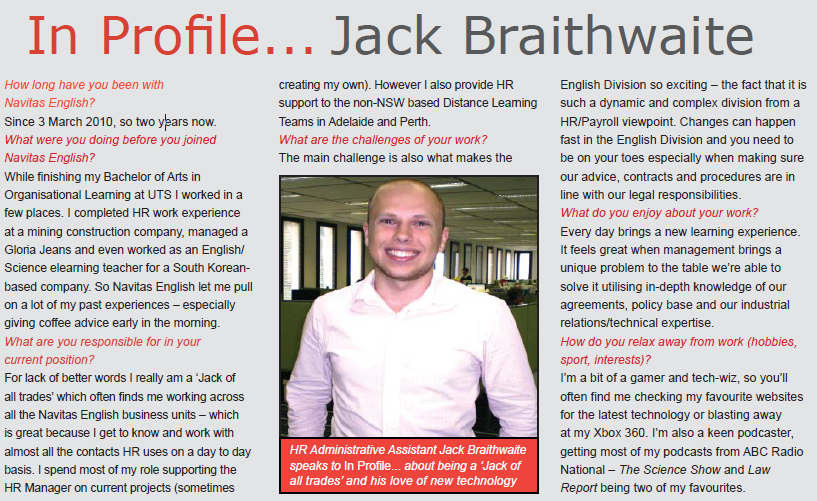
I appeared in the Autumn Navitas English company newsletter for their in profile section. Apparently I got a bit too excited when filling in their questionnaire and they had to edit me down to fit in! That aside, if you wanted to know a little bit more about me or what I do - the feature below should give you a better idea.
Monday, January 25, 2010
5 Questions - Laurence Giggacher, L&D Consultant
As a change of pace I decided to interview a friend and fellow graduate from UTS. Laurence also holds a Bachelor of Arts in Organisational Learning (BAOL) and has recently been hired by Stockland as a L&D Consultant.
I want to thank Laurence for kindly answering the following questions.
1. In a few words could you explain a little about Stockland and what attracted you to it?
Stockland is a diversifed Property Investment Group, speacilising in Commercial, Residential, Industrial and Retirement Living. They have offices all around Australia and in the UK located in London & Glasgow.They're also ASX listed and one of the Top Fortune 500 companies in Investment. There are roughly about 1500 employees working within Australia and use many training programs and professional excellence systems within Learning & Development to reach desired organisational performance in maintaining engagement. What attracted me to Stockland is their approach to ehancing employee engagement and giving the employee more freedom to explore their own career development and not just focusing on reaching company targets. Stockland provides me the chance to develop my professional skills , also learn about training whilst faciliating staff by understanding their career needs and personal progression. I thought this would be a great company to be apart of and how they focus on their people as important assets all working in a holistic function towards a common goal.
2. What you find was your greatest asset when selling yourself as a graduate?
I would have to say it was an amalgamation of my work experience & BAOL that helped me get this position.The BAOL enhanced their expectations of my skills and how I learnt about Human Resources in theoritical ways and were eager to see if I could apply them pratically in a business environment within the industry. Determination, ambition and the right attitude contributes to the level of potentail a candidate can deliver to the company. That's how I presented myself as a confident graduate willing to learn about HR and take on a challenge. If you approach a job interview with relevant knowledge,some experience and eager attitude it will enhance the chance of getting the position.
4. Have you found your perceptions of what L&D or HR is from university differ at all form your workplace context?
I only found that L&D differed from a university sense because what we learnt was being used theoritically instead of a practical approach describing the notions of HR. L&D is what I did percieve in Uni, in terms of its fundamental strategical element of training and designing programs for staff. L&D is all about enhancing productivity through training and developing new skills within the organisation. In a working context L&D does reach those aspects that we discussed in Uni. For example, at Uni we discussed the theory of TMS and 360 degree feedback and in the working context I currently use these 2 systems to monitor the level of engagement in Management and feedback based on these models. So to summarise BAOL really does focus on the fundamental notions of HR and provides a great introductory base for future career & industry knowledge.
5. How well have you felt your degree prepared you for the 9 to 5 of being in L&D?
To some degree I believe that the BAOL has given me insight to prepare for the 9 to 5 job each day. There may be some areas in which were not covered in the degree but that's the joy of learning on the job. Even though I had learnt much jargon, methods, theories and read numerous case studies in the degree, not all have been relevant to the working context of L&D. Although the relevant material that was used has been able to help me understand some modules and protocol that were easily recognised from previous class activites. My perception of the BAOL is that this degree will most likely be the best preparation for this industry and explores the core aspects of HR, so students can know what to expect when finishing uni. The workplacements within the degree also provide a lot of insight into the professional world.
For more information about the Bachelor of Arts in Organisational Learning see:
http://www.handbook.uts.edu.au/courses/c10231.html
Or for more information on Stockland visit:
http://www.stockland.com.au
I want to thank Laurence for kindly answering the following questions.
1. In a few words could you explain a little about Stockland and what attracted you to it?
Stockland is a diversifed Property Investment Group, speacilising in Commercial, Residential, Industrial and Retirement Living. They have offices all around Australia and in the UK located in London & Glasgow.They're also ASX listed and one of the Top Fortune 500 companies in Investment. There are roughly about 1500 employees working within Australia and use many training programs and professional excellence systems within Learning & Development to reach desired organisational performance in maintaining engagement. What attracted me to Stockland is their approach to ehancing employee engagement and giving the employee more freedom to explore their own career development and not just focusing on reaching company targets. Stockland provides me the chance to develop my professional skills , also learn about training whilst faciliating staff by understanding their career needs and personal progression. I thought this would be a great company to be apart of and how they focus on their people as important assets all working in a holistic function towards a common goal.
2. What you find was your greatest asset when selling yourself as a graduate?
I would have to say it was an amalgamation of my work experience & BAOL that helped me get this position.The BAOL enhanced their expectations of my skills and how I learnt about Human Resources in theoritical ways and were eager to see if I could apply them pratically in a business environment within the industry. Determination, ambition and the right attitude contributes to the level of potentail a candidate can deliver to the company. That's how I presented myself as a confident graduate willing to learn about HR and take on a challenge. If you approach a job interview with relevant knowledge,some experience and eager attitude it will enhance the chance of getting the position.
3. Were there any particularly notable challenges you had to overcome when breaking into the profession?
There weren't may notable challenges that i had to overcome once I moved into a professional environment. Stockland helped me fit straight into place by implementing their orientation program and provided a fellow colleague as a mentor. Some of the systems were hard to get used too but once the instructions were clearly provided it become quite easy to adapt.Organisational Hierarchy also was a slight notable challenge whilst addressing fellow colleagues but a good way to learn about professional acumen. At first the transition into professional work can be a little bit scary but after you meet all the staff, toured the office and learnt the daily protocol, you will feel at home. The best thing to do is ask a lot of questions and record the answers so it becomes easier for you in your daily operations.
There weren't may notable challenges that i had to overcome once I moved into a professional environment. Stockland helped me fit straight into place by implementing their orientation program and provided a fellow colleague as a mentor. Some of the systems were hard to get used too but once the instructions were clearly provided it become quite easy to adapt.Organisational Hierarchy also was a slight notable challenge whilst addressing fellow colleagues but a good way to learn about professional acumen. At first the transition into professional work can be a little bit scary but after you meet all the staff, toured the office and learnt the daily protocol, you will feel at home. The best thing to do is ask a lot of questions and record the answers so it becomes easier for you in your daily operations.
4. Have you found your perceptions of what L&D or HR is from university differ at all form your workplace context?
I only found that L&D differed from a university sense because what we learnt was being used theoritically instead of a practical approach describing the notions of HR. L&D is what I did percieve in Uni, in terms of its fundamental strategical element of training and designing programs for staff. L&D is all about enhancing productivity through training and developing new skills within the organisation. In a working context L&D does reach those aspects that we discussed in Uni. For example, at Uni we discussed the theory of TMS and 360 degree feedback and in the working context I currently use these 2 systems to monitor the level of engagement in Management and feedback based on these models. So to summarise BAOL really does focus on the fundamental notions of HR and provides a great introductory base for future career & industry knowledge.
5. How well have you felt your degree prepared you for the 9 to 5 of being in L&D?
To some degree I believe that the BAOL has given me insight to prepare for the 9 to 5 job each day. There may be some areas in which were not covered in the degree but that's the joy of learning on the job. Even though I had learnt much jargon, methods, theories and read numerous case studies in the degree, not all have been relevant to the working context of L&D. Although the relevant material that was used has been able to help me understand some modules and protocol that were easily recognised from previous class activites. My perception of the BAOL is that this degree will most likely be the best preparation for this industry and explores the core aspects of HR, so students can know what to expect when finishing uni. The workplacements within the degree also provide a lot of insight into the professional world.
For more information about the Bachelor of Arts in Organisational Learning see:
http://www.handbook.uts.edu.au/courses/c10231.html
Or for more information on Stockland visit:
http://www.stockland.com.au
Subscribe to:
Posts (Atom)